
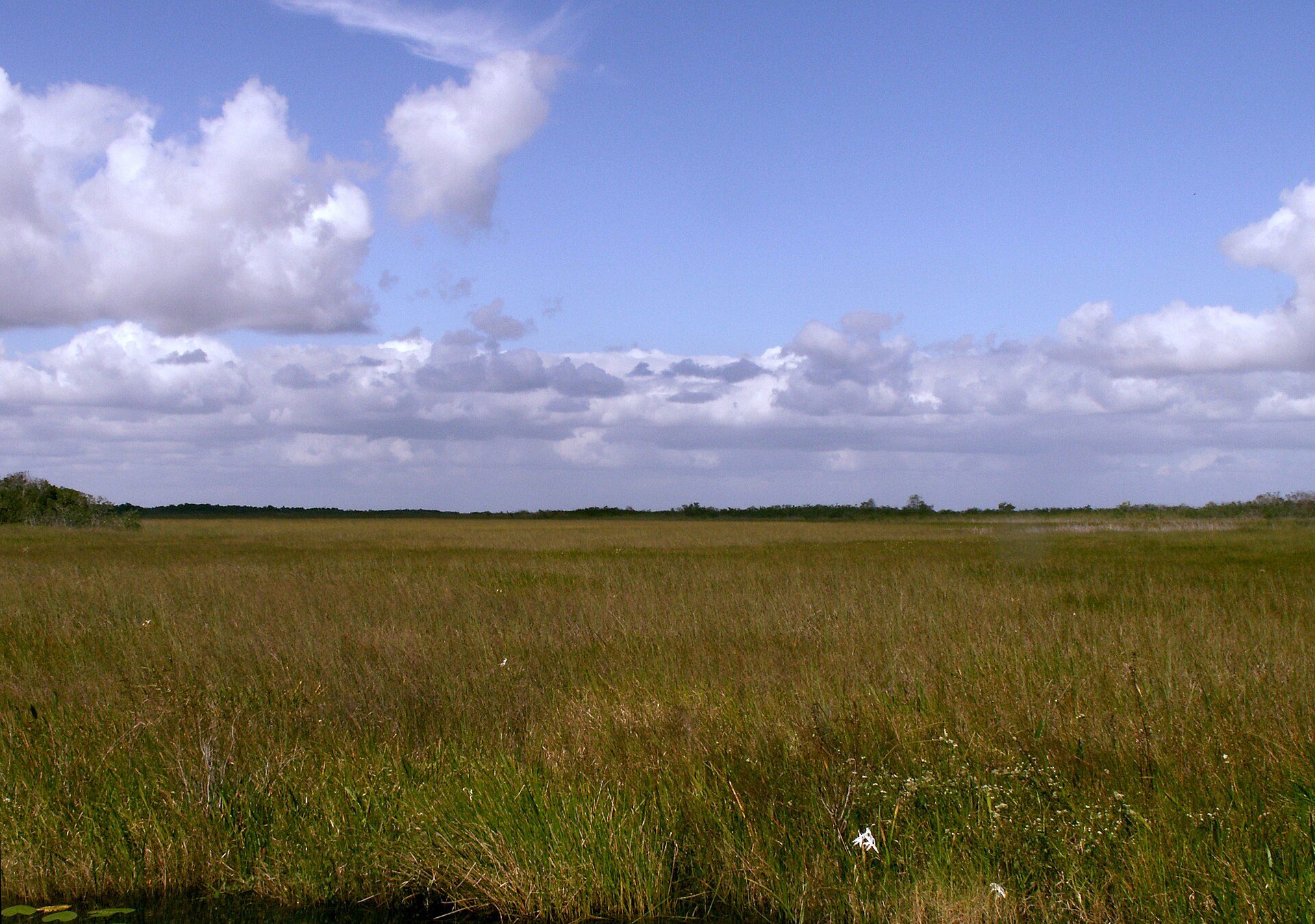
Before highways crossed South Florida, before subdivisions reached westward, there was water. Mile after mile of sawgrass moved beneath an enormous Florida sky — and the whole of it was going somewhere.
A river without banks
A century ago, water in South Florida moved along one connected path. It ran down the Kissimmee River into Lake Okeechobee, spilled south out of the lake and spread across the Everglades until it reached the mangrove estuaries of Florida Bay. The South Florida Water Management District describes the historic system as roughly 40 miles wide and 100 miles long, covering almost 11,000 square miles of South Florida.
The water did not travel in a channel. It moved as a broad, shallow sheet — sheetflow — so slowly that the movement is invisible to anyone standing in it. UNESCO’s description of the national park captures it: a river of grass flowing imperceptibly from the hinterland into the sea.
What the water built
That slow, seasonal flow shaped every habitat in the system: sawgrass marshes and deeper sloughs, tree islands and hardwood hammocks, and, at the coast, mangroves and the brackish waters of Florida Bay. Wading birds timed their nesting to the rise and fall of the water. Alligators dug holes that held water through the dry season and became refuges for fish, turtles and birds.
Draining the Glades
To early developers and state leaders, standing water was wasted land. Beginning in the early twentieth century, canals, levees and pumps drained the northern Everglades for agriculture and cleared the way for towns and cities along the coast. Roads cut across the marsh — the Tamiami Trail, opened in 1928, among them. According to the South Florida Water Management District, the Everglades today is about half the size it was a century ago.
The fight for a park
Protection began small. In 1916 Florida created Royal Palm State Park — about 4,000 acres — the first protected area in the Everglades. A landscape architect named Ernest F. Coe, who moved to Miami in 1925, turned the idea of a national park into a campaign. Congress authorized Everglades National Park on May 30, 1934, and President Harry S Truman dedicated it on December 6, 1947, at Everglades City. The same year, Marjory Stoneman Douglas published The Everglades: River of Grass.
A park that depends on water it does not control
Everglades National Park protects 1.5 million acres, according to the National Park Service. But the park sits at the downstream end of the system, and the water that sustains it is managed long before it arrives. UNESCO, which listed the park as a World Heritage Site in 1979, estimates that inflows have fallen by about 60 percent from pre-drainage levels and has twice placed the park on its List of World Heritage in Danger.
Restoration
In 2000 Congress approved the Comprehensive Everglades Restoration Plan, a long-term federal and state program to capture, clean and redirect more water south. The work continues today. Much of what happens next in the Everglades will again be a story about water.
Sources & References
- South Florida Water Management District — Everglades
- UNESCO World Heritage Centre — Everglades National Park
- National Park Service — Park Establishment
- National Park Service — Everglades FAQ
- Everglades Restoration Initiatives — Comprehensive Everglades Restoration Plan
- Miccosukee Tribe of Indians of Florida — A Brief History