
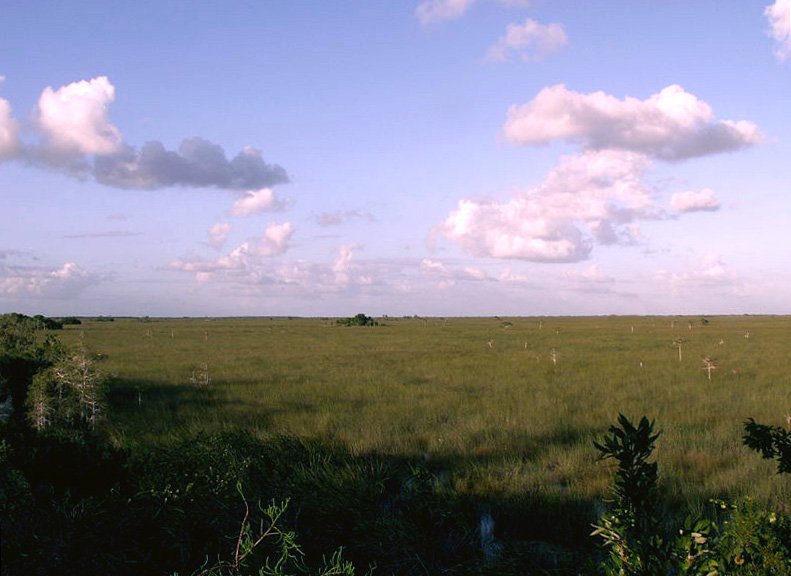
The history of the Everglades is the history of South Florida’s water — who lived with it, who tried to remove it, and who fought to bring it back. Start with the timeline, then meet the people.
Chapter Four
A Century in the Everglades
Select a year to open the record. Each entry names its source.
Early 1900s Draining the River of Grass
State-backed drainage, canals and levees begin converting the northern Everglades to farmland and making room for towns. Over the following century, drainage for agriculture, development and flood control cuts the Everglades to roughly half its historic size.
1916 Royal Palm State Park
Florida creates Royal Palm State Park — about 4,000 acres around Paradise Key — the first protected area in the Everglades. It would later become part of the national park.
1928 The Tamiami Trail opens
After thirteen years of construction begun in 1915, the road between Tampa and Miami opens across the Everglades in April 1928. It gives the region its first cross-state highway — and places a long dam across the natural southward flow of water. The same year, Ernest F. Coe’s Tropical Everglades National Park Association is organized.
Sources: Miccosukee Tribe of Indians of Florida; National Park Service
1934 A national park is authorized
On May 30, 1934, Congress authorizes Everglades National Park. The law sets the goal, but no land or money yet — assembling the park will take another thirteen years.
1947 River of Grass and the park’s dedication
Marjory Stoneman Douglas publishes The Everglades: River of Grass. On December 6, 1947, President Harry S Truman dedicates Everglades National Park at a ceremony in Everglades City.
Source: National Park Service
1962 Miccosukee federal recognition
In January 1962 the United States formally recognizes the Miccosukee Tribe of Indians of Florida, whose homelands lie along the Tamiami Trail.
1967 Endangered: the alligator and the snail kite
Hunting and habitat loss put the American alligator on the endangered list in 1967. The Everglades snail kite is listed the same year. The alligator recovers and is removed from the list in 1987.
Sources: National Park Service species profiles — American alligator, snail kite
1979 World Heritage Site
UNESCO inscribes Everglades National Park on the World Heritage List for its ecosystems and biodiversity. Because of damage to its water supply, it has since been placed on the List of World Heritage in Danger (1993–2007, and again from 2010).
Source: UNESCO World Heritage Centre
2000 The restoration plan
Congress approves the Comprehensive Everglades Restoration Plan (CERP) in the Water Resources Development Act of 2000 — a decades-long federal–state effort to get more clean water flowing south again.
Source: Everglades Restoration Initiatives (South Florida Ecosystem Restoration Task Force)
Today The river, still being argued over
Restoration projects continue across South Florida. UNESCO estimates that water inflows to the park have fallen by roughly 60 percent from pre-drainage levels — which is why the fight over the water is also the fight over the future of the place.
Source: UNESCO World Heritage Centre