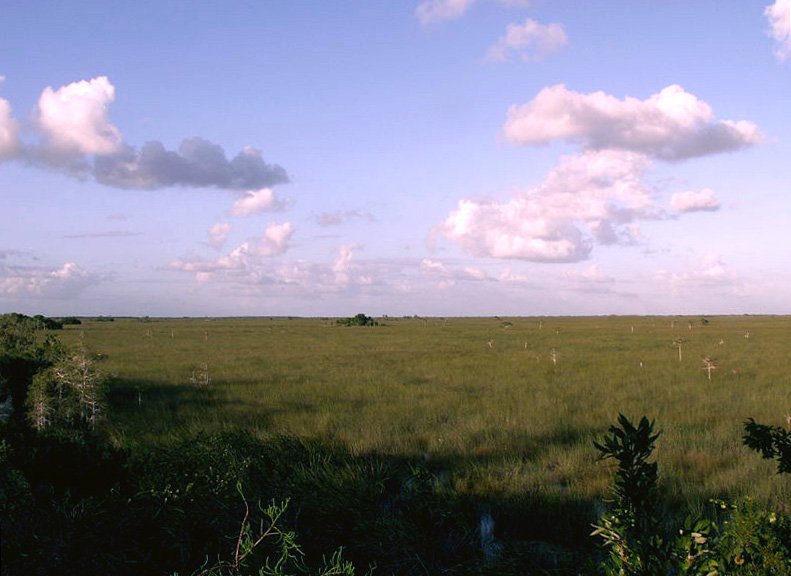
Stand at the edge of the sawgrass on a calm morning and nothing seems to move. The water is clear, shallow and apparently still. It is, in fact, on its way to the sea.
One system, top to bottom
The South Florida Water Management District describes the historic flow as a single connected pathway: water ran down the Kissimmee River into Lake Okeechobee, then south through the vast Everglades to Florida Bay — “the ultimate destination of uninterrupted sheetflow.”
What “sheetflow” means
There is no riverbed. Across a nearly flat landscape, water spreads into a broad, shallow sheet and drifts south so slowly that you cannot see it move. The historic system covered almost 11,000 square miles, roughly 40 miles wide and 100 miles long, according to the District. UNESCO describes the result as a river of grass flowing imperceptibly into the sea.
Why the distinction matters
A swamp can be drained and forgotten. A river cannot be cut without consequences downstream. As canals and levees drained the northern Everglades for farms, towns and flood control, less water reached the south. The District says the Everglades is now half the size it was a century ago; UNESCO estimates water inflows to the national park are down roughly 60 percent from pre-drainage levels.
Putting the river back
The Comprehensive Everglades Restoration Plan, approved by Congress in 2000, is built around that idea: store and clean water, then send more of it south in a pattern closer to the original flow. It is one of the largest environmental restoration efforts ever attempted — and it depends on understanding the Everglades as a river.
Frequently Asked Questions
Is the Everglades a swamp or a river?
Scientists and agencies describe the Everglades as a slow-moving river: historically, water flowed south from Lake Okeechobee through the sawgrass to Florida Bay as a broad, shallow sheet rather than in a channel.
How big was the original Everglades?
The South Florida Water Management District says the Everglades once covered almost 11,000 square miles of South Florida, roughly 40 miles wide and 100 miles long. About half remains today.
Who called the Everglades a “river of grass”?
The phrase is most closely associated with Marjory Stoneman Douglas, whose book The Everglades: River of Grass was published in 1947.